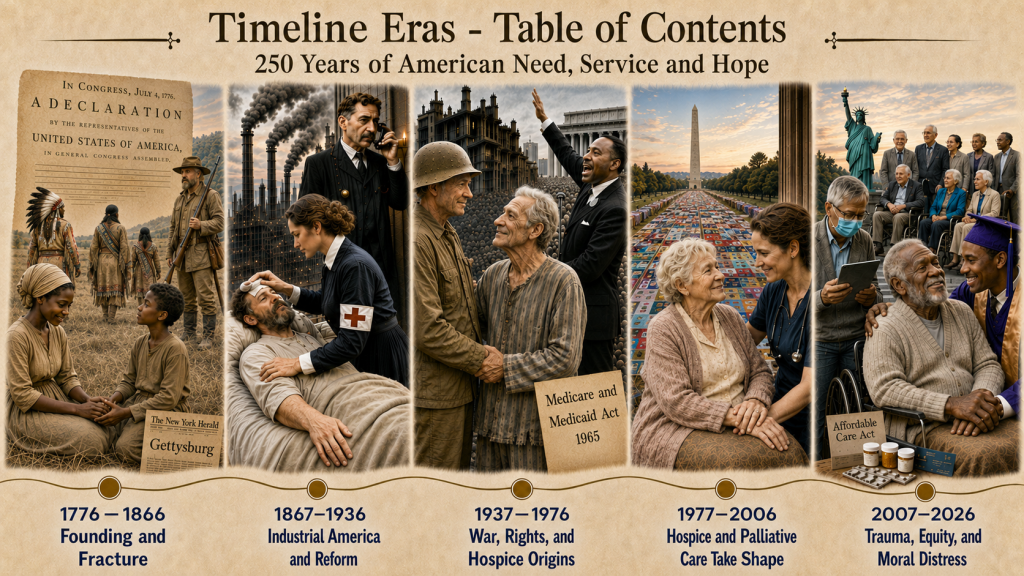
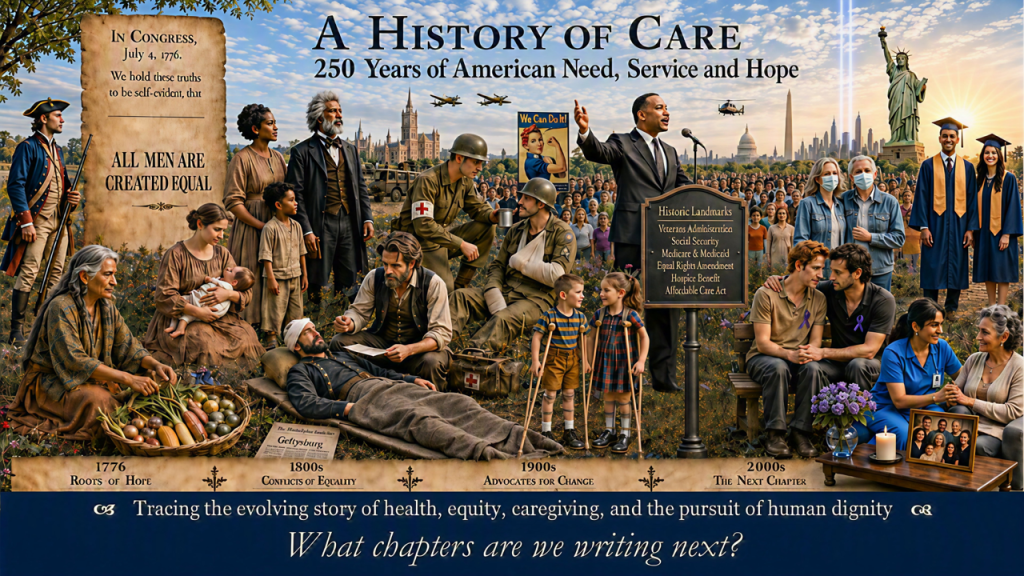
1977-2006: Hospice and Palliative Care Take Shape
Interwoven themes: Hospice from margins to Medicare and mainstream care. Interdisciplinary teams and maturing identities. AIDS, activism, and care amid stigma. High‑tech medicine and questions about dying. Palliative care entering hospitals and ICUs. Evidence, education, and quality in serious‑illness care.
Click on images below to go to decade-specific content

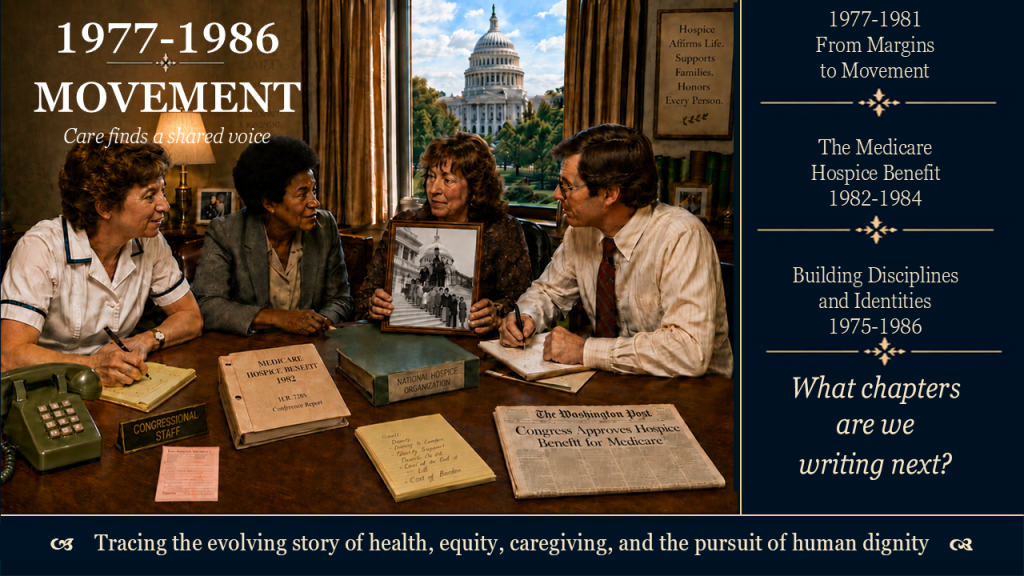
1977-1986
posted in Hospice & Palliative Care Today, June 30, 2026
1. From Margins to Movement (1977–1981)
- “Approaches to death and dying reveal much of the attitude of society as a whole to the individuals who compose it.” ~ Cicely Saunders
Historical context: By the late 1970s, “hospice” in the United States was taking root with compelling local programs, but with no solid policy or payment base. Federal interest grew through task forces and demonstration projects that tested hospice’s impact on costs, quality, and family experience. In 1978 the National Hospice Organization (NHO) formed, giving these visionary programs a shared voice, emerging standards, and a sense of being a collective movement rather than isolated pockets of care.
Today’s hospice and palliative care: This moment of care at the hospice bedside transforming into a national organization reminds us that growthful, sustainable innovation needs infrastructure, creativity, problem-solving, metrics, coalitions, and policy asks. Because of actions then and through the following decades, we are better together.
Sources: Cicely Saunders Quotes; Library of Congress National Hospice and Palliative Care

2. The Medicare Hospice Benefit (1982–1984)
- Policy is biography written in law.
Historical context: In 1982, Congress created the Medicare Hospice Benefit, initially as a temporary test within Medicare. It authorized payment for an interdisciplinary hospice team, largely home–based, with a focus on symptom control, family support, and defined benefit periods tied to a terminal prognosis. By 1984, the benefit was effectively established as a stable feature of Medicare, shifting hospice from philanthropy’s margins into the center of U.S. health care financing.
Today’s hospice and palliative care: The pendulum has swung from the Medicare Hospice Benefits—“what is hospice?”—to today’s horrendous abuses and fraud. Challenges are rampant: from the Medicare Hospice Moratorium of May 2026 to new payment systems and more, are we fragmenting or moving forward collectively? Our task now is to “write the next chapter,” advocating for systems that preserve hospice’s interdisciplinary, relationship–rich ethos while removing barriers that delay access and deepen inequities.
Sources: Medicare hospice benefit: Early program experiences; CMS.gov Hospice
3. Building Disciplines and Identities (1976–1986)
- Movements endure when they grow professions, not just programs.
Historical context: During these years, end-of-life care professionals were building a professional backbone, . Leading the way for end-of-life care in 1976, the Forum for Death Education and Counseling (now the international Association for Death Education and Counseling – ADEC) created one of the first interdisciplinary collaborations for dying, death, and bereavement. Specific to hospice, the National Hospice Organization (later the National Hospice & Palliative Care Organization and now the National Alliance for Care at Home) was founded in 1978 as the national voice for standards, data, and advocacy. Regional and discipline–specific groups followed: the Pennsylvania Hospice and Palliative Care Network (PHPCN) launched in 1980 as a statewide leader in hospice and palliative care education and advocacy, and by 1986 nurses formed the Hospice Nurses Association —later the Hospice and Palliative Nurses Association (HPNA)—to support hospice nursing as a specialty. Soon after in 1988, physicians established the Academy of Hospice Physicians (now AAHPM), confirming hospice and palliative medicine as a distinct medical community.
Today’s hospice and palliative care: Today’s hospice and palliative care still rest on the scaffolding these organizations built. NHO’s legacy and its successors remind us that serious-illness care needs a coherent national voice, especially as policy and payment models shift. ADEC and PHPCN point to the importance of international and regional and interdisciplinary forums where death, grief, and serious illness are treated as shared human concerns, not just technical problems. The emergence of HPNA and, soon after, AAHPM shows how vital strong professional homes are for sustaining expertise, ethics, and advocacy in end-of-life care. For leaders today, their example nudges us to keep investing in professional communities—local, national, and discipline-specific—that can carry hospice and palliative values into whatever new structures health care invents next.
Source: History of the National Hospice Organization; Association for Death Education and Counseling Celebrates 50 Years of Advancing Grief Education and End-of-Life Understanding; Pennsylvania Hospice and Palliative Care Network; Celebrating HPNA’s 40th Anniversary; AAHPM History

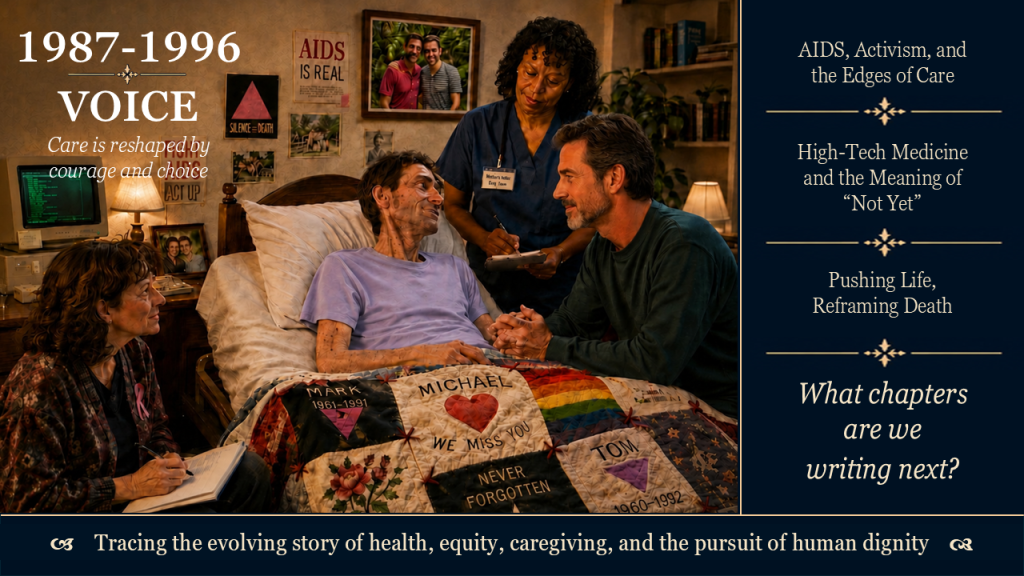
1987-1996
posted in Hospice & Palliative Care Today, July 1, 2026
1. AIDS, Activism, and the Edges of Care
- “It takes no compromising to give people their rights. It takes no money to respect the individual. It takes no survey to remove repressions.” ~ Harvey Milk, killed 1978
- “Because of the lack of education on AIDS, discrimination, fear, panic, and lies surrounded me.” ~ Ryan White, died of AIDS 1990
Historical context: By the late 1980s and early 1990s, AIDS had become a defining crucible for end–of–life care. In cities like San Francisco and New York, community–based hospices, AIDS residences, and hospital AIDS units emerged to care for mostly young adults facing rapid decline, stigma, and abandonment. Activist groups, faith communities, and grassroots caregivers built networks of practical help and political pressure, insisting on pain control, honest communication, and partner inclusion when formal systems failed. These efforts forced hard questions about who “deserved” care, what dignity meant in the midst of discrimination, and how to honor both fierce fighting for life and the need for a peaceful death.
Today’s hospice and palliative care: AIDS-era caregiving still challenges us. It reminds us that good end-of-life care is inseparable from justice work: confronting stigma, racism, homophobia, and poverty that shape how people live and die. It pushes today’s hospice and palliative teams to meet serious illness at the margins—homelessness, incarceration, substance use, immigration status—not just in well-resourced homes. And it invites us to hold together two truths: people have a right both to aggressive treatment when wanted and to a supported, relational death when cure is no longer possible.
Sources: New York City AIDS Memorial – HIV/AIDS Timeline of Crisis, Response, and Resilience; Pastoral Care and Public Memory: The AIDS Crisis
2. High-Tech Medicine and the Start of a Digital Era
- “I’m one of those people that think Thomas Edison and the light bulb changed the world more than Karl Marx ever did.” ~ Steve Jobs
Historical context: Desktop computers, word processors, and cheap printers replaced typewriters, speeding hospice and hospital documentation, care plans, and teaching materials. Early electronic records and billing systems began linking basic clinical data. Fax machines became the workhorse for referrals, DNR orders, and discharge summaries across hospitals, nursing homes, and hospices. At the same time, email, the early internet, and first telemedicine pilots showed that lab results, images, and consults could move quickly across distance, foreshadowing today’s connected infrastructure.
Today’s hospice and palliative care: Those tools evolved into EHRs that let teams respond quickly—sharing notes, meds, and goals–of–care plans across hospitals, hospices, and nursing facilities. Used well, they support rapid symptom response and safer handoffs; used poorly, they turn clinicians into data clerks and pull attention from the bedside. Social media now amplifies education and advocacy but also spreads misinformation and risks privacy, demanding firm ethical boundaries. Artificial intelligence is the newest force: promising early–warning flags, chart summaries, and language support, yet also carrying bias and transparency risks. The future task for hospice and palliative care is to harness these technologies to deepen presence, coordination, and equity—never to replace judgment, relationship, or the courage to sit in silence at the end of life.
Sources: Technologies to Support End of Life Care; The History of the Fax Machine; History of EHRs in healthcare technology; The ethical dimensions of utilizing Artificial Intelligence in palliative care
3. Pushing Life, Reframing Dying
- Modern medicine can often add time to a life; the harder question is whether we are adding to its meaning or only to its suffering.
Historical context: By the late 1980s and early 1990s, medicine was saving and extending more lives through organ transplantation, cancer therapies, and increasingly sophisticated heart surgery and devices. At the same time, high–profile cases and experiences—patients living months on artificial hearts or in ICUs with little chance of recovery—exposed how “rescue” could also prolong dying, disability, and family anguish. Earlier cases like Karen Ann Quinlan (mid–1970s) and later ones like Nancy Cruzan and others kept reverberating in this era, sharpening debates about feeding tubes, ventilators, and who decides when “enough” has been reached. The 1990 Patient Self–Determination Act emerged in that context, legally affirming the right to accept or refuse treatment and to use advance directives—not as an attack on progress, but as a safeguard against unwanted prolongation of suffering.
Today’s hospice and palliative care: This history warns us away from simple stories—neither “technology is bad” nor “more is always better.” Our daily work lives in the tension: celebrating transplants, targeted therapies, and ICU rescues that return people to living, while also naming when interventions are now only extending burden. Palliative care and hospice become the place where this dialectic is spoken out loud: helping people use advance directives and shared decision–making to say both “yes” and “no” to treatment, grounded in their values, culture, and relationships. For the future, the ethical task is to keep pairing innovation with honest prognostic conversations and person–centered care, so that the power to push life longer never outruns our courage to reframe dying well.
Sources: The history of organ transplantation; Patient Self-Determination Act Technology and Death; The Evolution of Health Care Advance Planning Law and Policy
1997-2006
posted in Hospice & Palliative Care Today, July 2, 2026
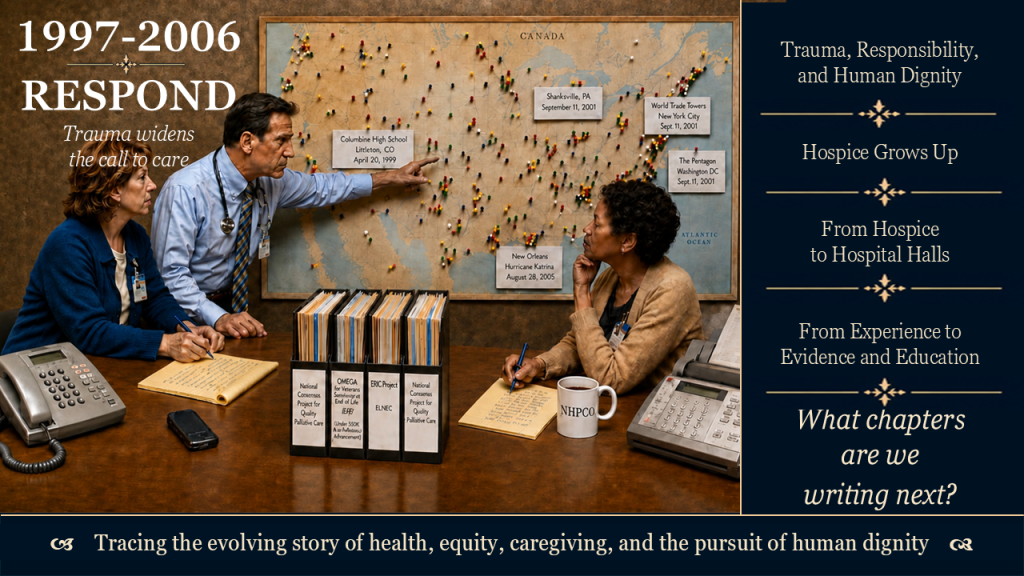
1. Trauma, Responsibility, and the Pursuit of Human Dignity
- “We have seen the decency of a loving and giving people who have made the grief of strangers their own.” ~ President George W. Bush, Address to a Joint Session of Congress and the American People, September 20, 2001
- “We just need some help out here. It is just so pitiful. Pitiful!” ~ Charles Evans, child survivor of Hurricane Katrina, NBC News, September 2, 2005
Historical context: The Columbine High School shootings on April 20, 1999, in Littleton, Colorado, marked the beginning of a new and deeply unsettling era of mass shootings and community trauma in the United States. The attacks of September 11, 2001 brought sudden, massive loss of life and demanded extraordinary courage from firefighters, police officers, emergency responders, and civilians who ran toward danger, many dying to save others. Four years later, Hurricane Katrina exposed how unevenly protection and rescue were distributed, as Black communities in New Orleans endured delayed evacuations, collapsed infrastructure, and days-long waits for food, water, and medical care. For many, Katrina confirmed that failures to respond to Black Americans’ suffering were part of a long history in which some neighborhoods and lives were treated as less urgent to save.
Today’s hospice and palliative care: Hospice and palliative care operate within larger systems of emergency preparedness, response, recovery, and mitigation. Local programs must plan for disrupted communications, unsafe roads, damaged homes and facilities, evacuation of medically fragile patients, interrupted access to oxygen, medications, and equipment, and the safety of staff whose own families and communities may also be in crisis.
Sources: Columbine High School massacre; The White House – President George W. Bush – Address to a Joint Session of Congress and the American People; Toxins and Health Impacts: Health Effects of 9/11; NBC News: Little Charles Evans Pleads for Help After Katrina; Hurricane Katrina 19 Years Later: What Policies Have Changed
2. Hospice Grows Up
- “There are stories that tell about holding people while they cry with the pains of this world, and then there are other stories that show the possibility of really coming full circle, of being transformed.” Rabbi Tsvi Blanchard, opening quote in The National Hospice Organization’s “Guide to Hospice Care” – The Hospice Choice – In Pursuit of a Peaceful Death, 1998
Historical context: In the late 1990s and early 2000s, hospice moved from experiment to expected option. Admissions rose into the hundreds of thousands annually, and the share of Medicare decedents using hospice climbed into the 20–25% range. Hospice in nursing homes and for non–cancer diagnoses increased, and national/state conferences and public–facing materials (like NHO’s Hospice Choice guide) helped families recognize hospice as a pathway toward “coming full circle,” not just a last resort. In 2000 NHO integrated “& Palliative Care” into its name, thus NHPCO.
Today’s hospice and palliative care: We inherit both this growth and its unfinished business. The stories that built hospice—as Rabbi Blanchard suggests—are about transformation as much as tears. That means ensuring excellence throughout our systems, teams, and payment models so that patients and families have the time together, support, and trust they need—for their grief, and for whatever transformations are possible at the end of a life.
Sources: The Hospice Choice – In Pursuit of a Peaceful Death; Important Questions for Hospice in the Next Century – 2000; National Hospice and Palliative Care Organization company history timeline
3. From Hospice to Hospital Halls: Palliative Care Finds Its Name
- “Death is unpredictable; this is why palliative care must be available to people at any stage of a serious illness – with or without curative treatment.” ~ Dr. Diane Meier, founder of the Center to Advance Palliative Care
Historical context: In 1999, the Center to Advance Palliative Care (CAPC) was founded at Mount Sinai with Robert Wood Johnson Foundation support to move palliative care from rare pilot programs to a mainstream hospital service. Around 2000, fewer than a quarter of U.S. hospitals with 50+ beds had a palliative–care team; by 2003 that number had already risen to about 25%, with programs growing fastest in larger, nonprofit, academic, and VA hospitals. CAPC’s early seminars, toolkits, and case studies helped hospitals build consult teams that brought symptom relief and goals–of–care conversations into ICUs, oncology wards, and emergency departments—not just hospice units.
Today’s hospice and palliative care: This hospital–based turn reshaped the landscape. Today, most larger hospitals have palliative–care teams, yet access still varies by region, hospital size, and ownership. For hospice, the rise of inpatient palliative care is both partner and challenge: it can foster earlier consults and smoother transitions, or keep patients in acute care too long. The future work is to knit these services together—hospital, home, nursing facility, clinic—so that “palliative care” describes a continuous thread of person–centered support, not a fragmented set of programs competing for patients and dollars.
Sources: Palliative care in hospitals; The Exponential Progress of Palliative Care Is a Tribute to CAPC on Its 25th Anniversary; The Case for Hospital Palliative Care; National Trends in Adult Hospice Use: 1991–1992 to 1999–2000
4. From Experience to Evidence and Education
- “Research and scholarship are essential to advance the science of hospice and palliative care and must inform clinical practice.” ~ HPNA Value Statement: Role of Hospice and Palliative Nurses in Advancing Research and Scholarship, 2022
Historical context: By the early 2000s, hospice and palliative care had generated enough data—and enough hard–won wisdom—that rigorous scientific research and compassionate clinical education became essential, not optional. Journals and curricula began to codify what bedside caregivers had long practiced: how to relieve suffering, support families, and honor dignity at the end of life.
- 1970 – OMEGA: Journal of Death and Dying
- 1984 – American Journal of Hospice & Palliative Medicine
- 1999 – Journal of Hospice & Palliative Nursing (JHPN)
- 1999 – Education for Physicians on End–of–Life Care (EPEC) Project
- 2000 – End–of–Life Nursing Education Consortium (ELNEC)
- 2005 – Journal of Social Work in End–of–Life & Palliative Care
Together, these journals and curricula carried hospice’s insights into broader palliative practice, turning bedside stories into research, syllabi, and a shared language.
Today’s hospice and palliative care: Today, these resources live mostly online: journals searchable in seconds, national policies and guidelines updated rapidly, with webinars, on–demand courses, and podcasts offered by nearly every major hospice and palliative care organization. Clinicians can find decades of rigorous scientific research and compassionate clinical education—24/7—from almost anywhere via mobile devices. We must use these tools to lift quality and equity, while ensuring that instant access and AI–driven systems strengthen—rather than weaken—our commitment to relieve suffering and improve person-centered quality of life.
Sources: HPNA Value Statement Role of Hospice and Palliative Nurses in Advancing Research and Scholarship Dr. Betty Ferrell and the Extraordinary Pursuit of Worldwide Palliative Nursing Education; HPCC History; OMEGA – Journal of Death and Dying; American Journal of Hospice & Palliative Medicine; Journal of Hospice & Palliative Nursing (JHPN); Education for Physicians on End–of–Life Care (EPEC) Project; End-of-Life Nursing Education Consortium (ELNEC); Journal of Social Work in End-of-Life & Palliative Care